Sunday, December 29, 2013

Commonly confused

I often confuse words by mixing up their spelling.There is a great amount of words which sound or look similiar. Spellcheckers on computers don't help much, they may underline a wrongly-spelled word but they don't check the right usage of a word. As a result, it is important to be aware of the differences in spelling of certain words and to avoid misusage.

For example:
‘A historic event’ or ‘an historic event’?
‘All right’ or ‘alright’?
‘Among’ or ‘amongst’?


I just wanted to share this great table to help you and me avoid spelling mistakes:

Word
Meaning
Word
Meaning
accept
to agree to receive or do
except
not including
adverse
unfavourable, harmful
averse
strongly disliking; opposed
advice
recommendations about what to do
advise
to recommend something
affect
to change or make a difference to
effect
a result; to bring about a result
aisle
a passage between rows of seats
isle
an island
all together
all in one place, all at once
altogether
completely; on the whole
along
moving or extending horizontally on
a long
referring to something of great length
aloud
out loud
allowed
permitted
altar
a sacred table in a church
alter
to change
amoral
not concerned with right or wrong
immoral
not following accepted moral standards
appraise
to assess
apprise
to inform someone
assent
agreement, approval
ascent
the action of rising or climbing up
aural
relating to the ears or hearing
oral
relating to the mouth; spoken
balmy
pleasantly warm
barmy
foolish, crazy
bare
naked; to uncover
bear
to carry; to put up with
bated
in phrase 'with bated breath', i.e. in great suspense
baited
with bait attached or inserted
bazaar
a Middle Eastern market
bizarre
strange
berth
a bunk in a ship, train, etc.
birth
the emergence of a baby from the womb
born
having started life
borne
carried
bough
a branch of a tree
bow
to bend the head; the front of a ship
brake
a device for stopping a vehicle; to stop a vehicle
break
to separate into pieces; a pause
breach
to break through, or break a rule; a gap
breech
the back part of a gun barrel
broach
to raise a subject for discussion
brooch
a piece of jewellery
canvas
a type of strong cloth
canvass
to seek people’s votes
censure
to criticize strongly
censor
to ban parts of a book or film; a person who does this
cereal
a grass producing an edible grain; a breakfast food made from grains
serial
happening in a series
chord
a group of musical notes
cord
a length of string; a cord-like body part
climactic
forming a climax
climatic
relating to climate
coarse
rough
course
a direction; a school subject; part of a meal
complacent
smug and self-satisfied
complaisant
willing to please
complement
to add to so as to improve; an addition that improves something
compliment
to praise or express approval; an admiring remark
council
a group of people who manage or advise
counsel
advice; to advise
cue
a signal for action; a wooden rod
queue
a line of people or vehicles
curb
to keep something in check; a control or limit
kerb
(in British English) the stone edge of a pavement
currant
a dried grape
current
happening now; a flow of water, air, or electricity
defuse
to make a situation less tense
diffuse
to spread over a wide area
desert
a waterless, empty area; to abandon someone
dessert
the sweet course of a meal
discreet
careful not to attract attention
discrete
separate and distinct
disinterested
impartial
uninterested
not interested
draught
a current of air
draft
a first version of a piece of writing
draw
an even score at the end of a game
drawer
a sliding storage compartment
dual
having two parts
duel
a fight or contest between two people
elicit
to draw out a reply or reaction
illicit
not allowed by law or rules
ensure
to make certain that something will happen
insure
to provide compensation if a person dies or property is damaged
envelop
to cover or surround
envelope
a paper container for a letter
exercise
physical activity; to do physical activity
exorcise
to drive out an evil spirit
fawn
a young deer; light brown
faun
a mythical being, part man, part goat
flaunt
to display ostentatiously
flout
to disregard a rule
flounder
to move clumsily; to have difficulty doing something
founder
to fail
forbear
to refrain
forebear
an ancestor
foreword
an introduction to a book
forward
onwards, ahead
freeze
to turn to ice
frieze
a decoration along a wall
grisly
gruesome, revolting
grizzly
a type of bear
hoard
a store
horde
a large crowd of people
imply
to suggest indirectly
infer
to draw a conclusion
loath
reluctant, unwilling
loathe
to hate
loose
to unfasten; to set free
lose
to be deprived of; to be unable to find
meter
a measuring device
metre
a metric unit; rhythm in verse
militate
to be a powerful factor against
mitigate
to make less severe
palate
the roof of the mouth
palette
a board for mixing colours
pedal
a foot-operated lever
peddle
to sell goods
pole
a long, slender piece of wood
poll
voting in an election
pour
to flow or cause to flow
pore
a tiny opening; to study something closely
practice
the use of an idea or method; the work or business of a doctor, dentist, etc.
practise
to do something repeatedly to gain skill; to do something regularly
prescribe
to authorize use of medicine; to order authoritatively
proscribe
to officially forbid something
principal
most important; the head of a school
principle
a fundamental rule or belief
sceptic
a person inclined to doubt
septic
infected with bacteria
sight
the ability to see
site
a location
stationary
not moving
stationery
writing materials
storey
a level of a building
story
a tale or account
titillate
to arouse interest
titivate
to make more attractive
tortuous
full of twists; complex
torturous
full of pain or suffering
wreath
a ring-shaped arrangement of flowers etc.
wreathe
to surround or encircle

British vs. American English

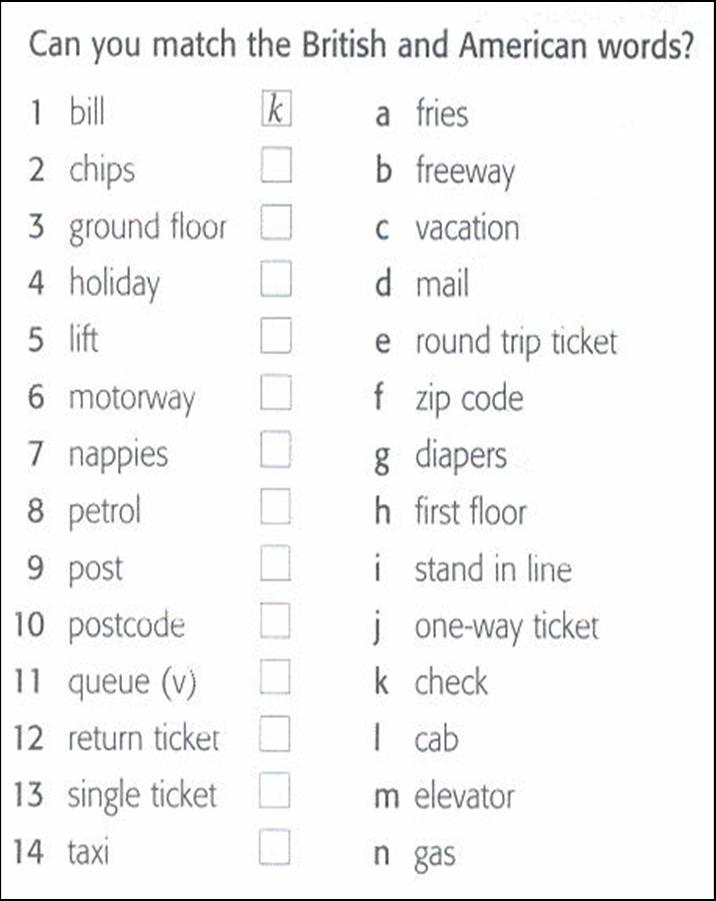
Although most schools in Europe only teach British English, many language learners have difficulties
distinguishing American English from British. Besides the differences in spelling, pronunciation and stress there are major vocabulary dissimilarities. There are different words for the same concepts. This is a short overview of the biggest differences between these two languages.
A complete article of the differences between British and American English can be found here.

Why these differences?
In the early 17th century the English language was introduced to Americans through the British colonization.  Due to the strength of the British Empire, the language spread rapidly throughout the world. Spoken in so many countries, various dialects and spelling differences of the English language developed. Most American accents remained rhotic ( the R is pronounced as in hard)  whereas in southern England the prestige non-rhotic accent was standardized. However, there are fascinating exceptions: New York and New England became non-rhotic; and Irish and Scottish accents remained rhotic.

Differences in use of tenses
In British English the present perfect is used to express an action that has occurred in the recent past and has an effect on the present moment. For example: I've misplaced my pen. Can you help me find it? In American English, the use of the past tense is also acceptable: I misplaced my pen. Can you help me find it? In British English, however, using the past tense in this example would considered to be incorrect.


Prepositions
There are also a few differences in preposition use including the following:
  • American English - on the weekend
    British English - at the weekend
  • American English - on a team
    British English - in a team
  • American English - please write me soon
    British English - please write to me soon

 Vocab differences


Time telling
Both languages have a slightly different structure of telling the time. While the British would say quarter past ten to 10:15, it is common in America to say quarter after or even a quarter after ten.Thirty minutes after the hour is called half past in both languages. Americans always write digital times with a colon, such as 6:00, whereas Britons often use a point, 6.00.


Probably the funniest way to explore the differences between British and American English is by taking a look at their slang words:

Imagine inviting a British friend to your American apartment. After being there for a while, she might get hungry and ask for the larder. No? What about cupboard? Eventually you realize, she ment pantry. Later, you schedule a date for the next visit and she writes it down in her diary while you mark it in your calender. When she calls you on the phone she rings you up but if the line was busy, she would say the line was engaged. Why is the line getting married?
The other day she told you a story about a pissed woman. Why is the woman so angry, you wondered? Actually, what she ment was that the woman was extremely drunk.

Imagine a young British couple, which just got married, hosting a dinner for their parents. They have put in a great amount of effort to prepare their home and the meal to impress. The bride’s father says: “Well, let me have a butchers at your spotted dick.” This family knows that have a butchers means to have a look, and that the spotted dick is a dessert made of pudding and dried fruit. The Americans, however, might be wondering what STD the groom has and why on earth would he be letting his father-in-law have a butchers at him, whatever that means! In any case, using the word butcher in a sentence with the slang word for a certain male body part, most American men cross their legs simultaneously. 

Imagine a young American couple close to their wedding date. The bride-to-be might say to her fiance: “Honey, our wedding is only two months away - I think we need to take some shagging lessons.”  Shagging is a popular swing dance in the US. The British, however, would think it is quite humourous that this woman is suggesting lessons in sexual intercourse. That is the British meaning for the slang word shagging. My husband really gets a kick out of the Shagging Contests that are announced over the radio here.

Other words:
Before I go on stage I often get the collywobbles.
He is so minted. Look at his car!
Don't talk tosh.
Your friend is a real wazzock, I'm sorry to say that.
Did you see Jennifer Lawrence fall arse over tit at the Oscars?
Don't drink plonk when you plan to rumpy pumpy later.
Everytime when you are legless you're miffed, gobby and the night ends balls-up.

Look up the words, you didn't understand from above.


Only know the American word and want to find the British equivalent?
This might help here


Fabulous glossary of many British words can be found here.


further reading:
http://www15.uta.fi/FAST/US1/REF/usgbintr.html

http://www.buzzfeed.com/mackenziekruvant/british-slang-americans-should-start-using


glossary (1) 
glossary (2)
wikipedia glossary


Saturday, December 28, 2013

New Year's Eve

Eating grapes at midnight? Molt metal and drop it into water? Street bonfires? Celebrating New Years Eve in summer? Go swimming at midnight?
You may have heard of different New Year's traditions from all around the world but how do they differ from each other and how crazy does it really get in some countries?
No day is awaited, observed and celebrated in so many different ways than New Year's Eve. On top of that, all around the world people have there own traditions and beliefes for this special evening.  

Probably the most popular custom on New Year's are resolutions. At first, being a tradition only in  Babylon, New Year's Eve resolutions are now spread world-wide. It is believed that this tradition is supposed to help realizing past mistakes in order to avoid them in the following year as well as helping to continue the good in people's lives. Resolutions are welcome opportunity for a "clean start" to a new year full of chances. Secondly, fireworks are established in New Year's celebrations world-wide as well. The noise and fire are thought to dispel evel spirits and bring good luck. Unfortunately, several accidents and even deaths occur every year.


South Africa
People throw old appliances out of the window. Careful!


Colombia
Empty suitcases are being carried around the
blocks with hopes for more possibilities to travel in the coming year.


Denmark
Old dishes are saved over the year and held to friends' and relatives' doors, then thrown on their doorsteps. The more broken dishes are found in front of a door, the more friends and luck one will receive the following year.


Spain
12 grapes are eaten in the last 12 seconds of the year. They are supposed to bring luck for the 12 months of the following year.


Finland
To predict the coming year, molten tin is thrown into cold water and then after hardening interpreted by its shape. A ring means an upcoming wedding, an animal means lots of food in the following year. Although it is adapted by many European countries, originally it is a finish tradition.


Panama
Dolls (muñecos) of well-known people, especially the ones who became popular that year, are burned in bonfires on the street. They represent the old year and by burning them people show that they are ready for the new.


Scotland
New Year's Eve is also called Hogmanay ( great love day). To bring in good luck for the following year, the first person stepping through your door is preferably tall, dark-haired with bread, salt and whiskey. This is apparently is a throwback to the day when rude vikings were feared. Balls of fire are carried through the street as well.


Philipines
Round shapes are a symbol for luck. Round fruits are eaten and clothes with polka dots are worn.


Belarus
Two plates with pile of corn are placed in front of two unmarried women. A rooster is put in the middle of the two plates and whichever plate he picks first from, the woman next to it will get married the following year.


Estonia
Whoever eats more than seven full meals on New Year's Eve will have enough food in the upcoming year. Some younger inhabitants altered this to seven shots of alcohol.


Central and South America
By wearing underwear of a certain color, you wish for special things in the following year.


Brazil
Jump 7 times in the sea for luck for every day of the week of the following year.


New Zealand
Cans and pots are slammed as loud and hard as possible to dispel evel spirits.


Russia
One wish is written on a piece of paper, burnt and thrown into a glass of champagne. This has to be drunk before midnight.


There are, of course, many more traditions which are too long for this post.
Simply, all this customs and tradition show the love and hope for the upcoming year.

Further reading for more traditions:
http://www.123newyear.com/newyear-traditions/

http://www.fathertimes.net/traditions.htm

http://www.cracked.com/quick-fixes/4-insane-new-years-celebrations-from-around-world/

Pictures
 http://www.theatlantic.com/infocus/2013/01/new-years-celebrations-around-the-world/100431/
http://www.frommers.com/slideshows/817351-new-year-s-eve-celebrations-around-the-world#slide840213


and a video:

Love is...


Printed in many daily newspapers Love is... comics strips are one of the most used quotes worldwide. They are translated into every European language, Indonesian, Korean Icelandic and so on and so forth. Originally, these little strips were created by Kim Casali for her husband. As a result of the great response to the first published  strips in 1970, Love is... became enormously famous. Books, newspapers, gifts, gift cards, comics, posters and many more a filled with these strips. At the height of their popularity the cartoons were earning Kim Casali £4-5 million annually. After Roberto Casali, Kim's husband, was diagnosed with cancer, Bill Asprey took over the writing and drawing of the famous cartoons. Nonetheless, Love is... comic strips are still signed with Kim Casali's signature.

The strips mostly show the same two persons: a male with dark black, short hair and a female with blond, waist-length hair. These two are featured throughout their lives. First as children, then as boyfriend and girlfriend and eventually as husband and wife. Furthermore, in some strips they appear with their own children and/or pets. The characters never change form or appearance; generally they look them same in every strip. Usually, the cartoon deals with light issues, however, messages concerning environmental problems and human right are also featured in some strips.
Each strip is independent of the other; there is no "series" or connection between them.

Reasons why these cartoons are so popular vary among people. In general, these strips describe relationship issues perfectly, therefore, people greatly identify themselves with these cartoons.


Although the characters are shown in the nude in most of the strips there are still some strips which are rejected to publish,
take a look:
http://theendofhumor.blogspot.co.at/

The cartoon also has an official application on the Apple's iTunes store at www.loveisapplication.com


Some of the many Love is... comic strips:
http://www.youtube.com/watch?v=QcxZjzx9clA

https://www.google.at/search?q=love+is&tbm=isch&tbo=u&source=univ&sa=X&ei=0ee-UuGjM6XRywPe14DoAg&ved=0CDcQsAQ&biw=1366&bih=576#imgdii=_